
Not too long ago, I had the occasion to stumble upon a social media post that trumpeted the KJV Bible. There were a series of images featuring various items in each, for example a KJV Bible against a background of stars, a devout man on his knees, and one with the letters KJV and nothing else. I had to respond. I took the opportunity to suggest to the poster of the content that unfortunately the KJV was not all it was cracked up to be. Needless to say, the response was accusatory. It was suggested I was being demonic and hateful. More images in defence of the KJV followed, some detailing various items that comprised what is likely a veritable mythology that surrounds the KJV and is used to promote people worshipping the KJV more than Jesus Christ. For example, there was an image claiming that there had been 7 significant and historical ‘received’ texts (as in divinely inspired), and the KJV was number 7. Lol!
I offered a more detailed reply, for example noting that of the 7 ‘received’ texts there were no ‘original’ Hebrew scriptures as those had been lost and that the dates were wrong for the Hebrew and the Greek texts. There were other problems I no longer recall.
Expecting a further rebuttal, I discovered as is so often the case, a complete refusal to engage, and worse, the removal of the entire post and replies! Indeed.
Gone.
Nonetheless, since I had in preparation for the next leg of it sketched some further remarks, in this post we will build upon those as we go through a few items of note regarding wee James and his Bible.
Over the course of this blog I have discovered holes in the KJV big enough to drive a truck through, and since I have previously and not too long ago remarked that I really should get down to a post on the KJV, this ladies and gentlemen is it.
So, without further adieu, it may perhaps be best to get down to some history on ye olde KJV first…
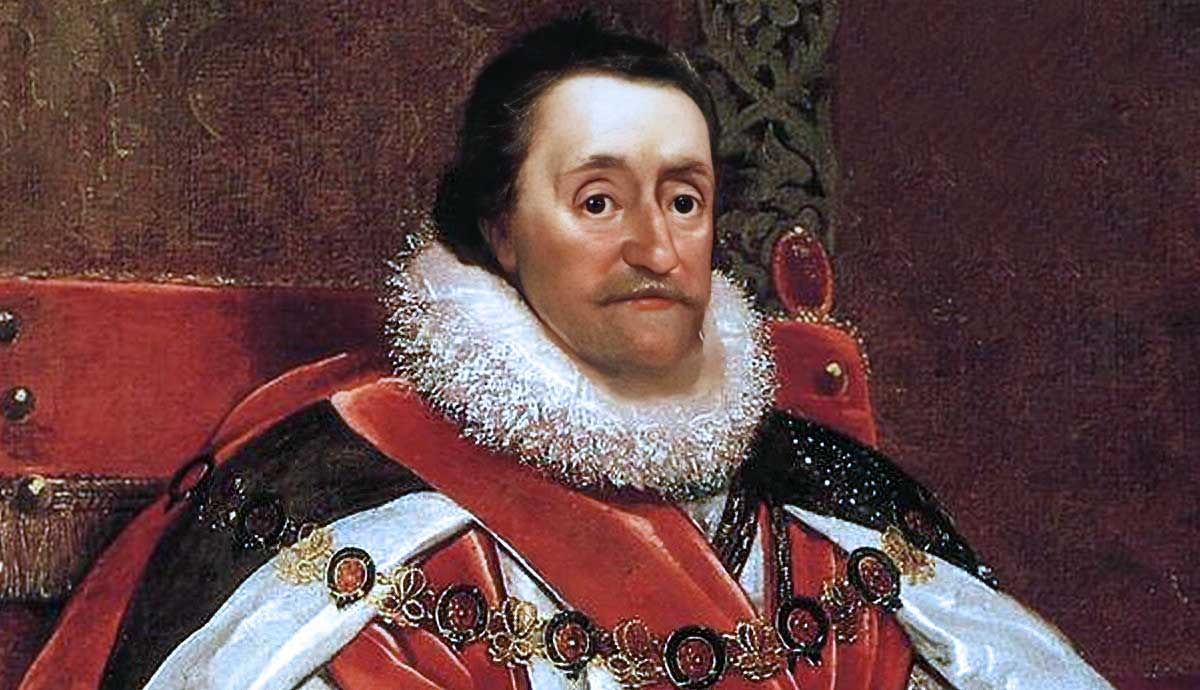
“James VI and I (James Charles Stuart; 19 June 1566 – 27 March 1625) was King of Scotland as James VI from 24 July 1567, and King of England and Ireland as James I from the union of the Scottish and English crowns on 24 March 1603, until his death in 1625. James was the son of Mary, Queen of Scots, and a great-great-grandson of Henry VII, King of England and Lord of Ireland, and thus a potential successor to all three thrones. He acceded to the Scottish throne at the age of thirteen months, after his mother was forced to abdicate. Although his mother was a Catholic, James was raised as a Protestant.” Wiki
“The Tudor Dynasty had arisen from the Welsh family, the Tudors of Penmynydd, who had taken the English Throne through the Battle of the Roses (1455 to 1487). Henry VII had managed to gain support from the Lancastrians and the Yorks to succeed the throne through right of conquest.
The word ‘conquest’ coincides with William the Conqueror in 1066 in which the ownership of land is determined. Yet the terms of that ownership have not been explained enough through history as to how it impacts today’s world – and it is significant. Conquest, when looked at in law brings certain duties and obligations as a trustee of another’s land. These battles between the various factions were about the authority to be the feudal lord and tenant the lands. In the Battle of the Roses, the Tudors had overcome the Plantagenets to gain the trusteeship and lease the lands of England and Wales.
When we take a step back, the Magna Carta had recognised the Free Church of England (under the Archbishop of Canterbury), was agreed by the Plantagenet Dynasty. What is proposed in history is that the disagreements between the Catholic Church and Henry VIII were his marital issues, and that he wanted an annulment from the Pope. (Editor’s aside: Lol!)
More to the point, the Tudors did not bind themselves to the Catholic Church as the Plantagenets had, yet the Catholic Church still wanted their own way. What followed, expressed that Henry VIII was not bound to them. With this, Henry had the ability to change the Acts of Parliament and install himself as head of the Church of England and throw out the Catholic Church.
The break with Rome was put in place by a series of Acts of Parliament passed between 1532 and 1534, among them the Act of Supremacy, which declared that Henry was the “Supreme Head on Earth of the Church of England.” This title was later renounced by Mary I, Henry’s daughter, in 1533 during the process of restoring the Catholic jurisdiction. Yet, when Elizabeth I, Mary’s sister, reasserted the royal supremacy in 1559, her title was “Supreme Governor.” Final authority in doctrinal and legal disputes now rested with the Monarch; the papacy was deprived of revenue and the monarch had the final say on the appointment of bishops.” p.23 “Who Is The Government” Ewan Campbell
‘James I of England was not a Holy man. He was a politician who believed kings were divinely appointed and untouchable. Before a single page was written James issued 15 rules to his translators; rules designed to protect his crown not your soul. Archbishop Bancroft was James enforcer. he supervised every word. Any scholar who deviated from the rules was removed; permanently. Rule #1: Follow the Bishop’s Bible not the Geneva Bible. Why? Because the Geneva Bible had footnotes calling kings tyrants. The Geneva Bible called out corrupt rulers by name in its’ footnotes. James banned it. He needed a bible where kings answered to no one. James didn’t commission this bible to spread the gospel. He commissioned it to spread compliance. Ecclesiastical words like Church must be kept. Why? Because ecclesia means free gathering. Church means hierarchy with a bishop at the top. The word ‘Bishop’ appears 128 times in the King James New Testament. In the Greek it’s ‘episcopos’; community overseer; not a ruler. ‘Ecclesia’ means ‘called out assembly’ or free people gathering voluntarily. No hierarchy required. No building required. No Bishop required. The original Greek ‘Ecclesia’ appears 155 times. The word ‘church’ in the KJV appears 112. Rule: Do not alter the Bishop’s Bible text without justification. Translation: Do not follow the Greek if it contradicts the institution – ever. Rule: Any company in doubt send it to the Bishops, then to the Privy Council. James himself had final authority over every verse. The Greek word ‘dulos’ means slave, an owned person with zero rights. The King James translated it as ‘servant’ 200 times. James built a Bible for an empire and for 400 years that empire used it, not to preach liberation but to preach compliance to the colonised.
Before commissioning the Bible, James wrote a book called “The True Law of Free Monarchies.” It’s thesis was that Kings are God’s representatives on earth and that subjects have no right to resist a king ever because to resist a king was to resist the will of God. The Geneva Bible had a footnote for Romans 13 that said: “Rulers who abuse power lose God’s mandate.” James deleted that note then published Romans 13 as absolute obedience to any ruler including himself. By that logic, the Apostles should have obeyed Rome, Peter should have stopped teaching and Paul should have renounced Christ.
The King James Bible is the most powerful piece of political propaganda ever produced in the English language done in scholars names with a king’s agenda. Jesus did not preach compliance. he preached reversal. The last shall be first. The mighty shall be brought down.” The Hidden Politics of The King James Bible.
OK!
Fair bit to unpack there. I’ll leave it to you dear reader to go over that material in your own time. It is my personal feeling that this ‘Protestant’ thing that began in Germany, and had a flourish of sorts in England, truly found its’ way to the Americas, particularly the New England Colonies where the colonists would take their poor treatment by the Kings of Great Britain and the Chartered Companies thereof to it’s logical ‘Protestant’ conclusion; Revolution. Tyrants would be called out and thrown off. Long live 1776!
As noted above in the Wiki, James was born a Catholic and raised a ‘Protestant’, whatever that means. It is worth noting that from William the Conqueror in 1066 through to Richard III in 1483, 17 kings of England were crowned under the Catholic ‘St Edward’s Crown’, named for Edward I which, was made a saint of the Roman Catholic Church.
Henry VII was the first King of England to be crowned under the Tudor Crown, which was not bound to the Catholic Church. Henry VIII, Edward VI, Mary and Elizabeth I were all crowned under the Tudor crown of England, unbound to Rome.
James VI/I was crowned once again under the ‘St Edward’s Crown’ in 1603. Rome returned to England. Further evidence of this Rome-based power of continental Europe coming back into England was the creation of the Virginia Company in North America chartered by King James in 1606. As seen in the stained glass relief of the Coat of Arms of the Virginia Company, the large, fat, deep red cross in the middle is the cross of the Knights Templars/Hospitallers to whom the charter was granted; a Roman Catholic Military Order.
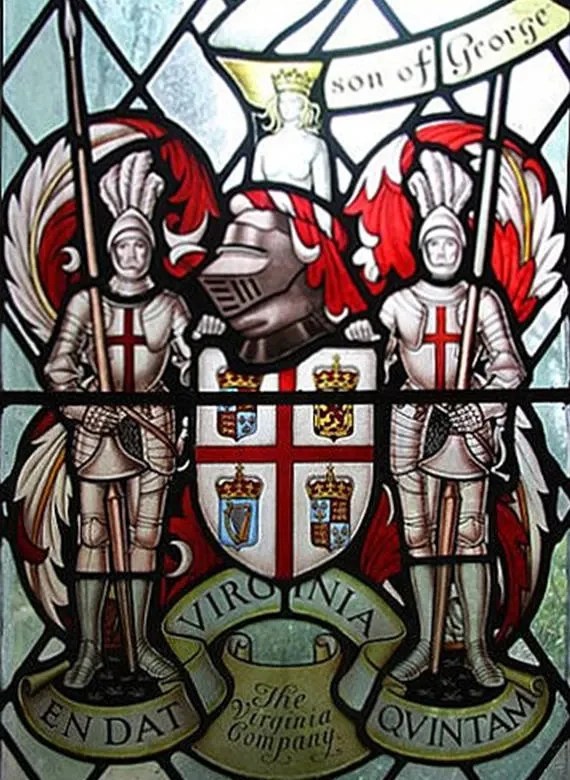
Folks, these are the very Roman Catholic Military Orders Henry VIII had thrown out of England. Can you say ‘back in black’? ‘Protestant’ flag wavers of the ‘Union Jack’ beware. That is not the Henry VIII cross of St George of England up front but the cross of the Roman Catholic Hospitallers/Templars!
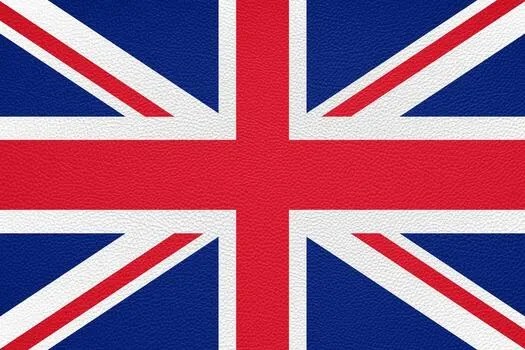
Or, it could also be the very St George’s Cross of the Order of St George (House of Habsburg).
It should not be lost on the general public that Britain was of course a province of ancient Rome at the time of our Lord and saviour Jesus Christ. It was James VI/I which, declared he would be “the first king of Great Britain”, a term his lawyer Francis Bacon would inform him had no legal status at that time. Yet, the intent was clear and the goal established.
“James was the great-great grandson of Henry VII King of England and the son of Mary Queen of Scots. He styled himself “King of Great Britain and Ireland” and would be the first of the Stuart Kings. By his titles and actions, James I would be British instead of English. This came about through a proclamation on the 20th Day of October 1604, in which the two estates of England and Scotland, held by James I & VI, were merged to create the new Imperial Crown of Great Britain.” p.28 “Who Is The Government?’ Ewan Campbell
Now, to be fair to the KJV, compared with something like the Douay-Rheims Bible, there probably isn’t much doubt; the KJV would be superior in much of its’ accuracy. While a head to head comparison of one against the other isn’t really possible here in this post there are no doubt scholars that would be only too happy to oblige you of such details. One example of such a comparison comes from an SDA named Walter Veith. The various theological messages of Mr Veith aside, this presentation illustrates several differences between the two Bibles.
Yet, such presentations as these entirely miss the point. The KJV, like ALL modern English Bibles is inherently corrupt due to the mixing of Pharisee generated, Hebrew ‘Masoretic’ Old Testament (compiled, edited and distributed by Jewish scholars known as the Masoretes in the 7th to 10th Centuries after Christ) with the New Testament Greek (notwithstanding the various rules James imposed upon his translators noted above). As we have discussed in our post ‘It’s All Greek To Me’ one can only conclude that while the KJV is a solid general Bible with notable phrasing, for any seekers of real scriptural truth out there, the KJV unfortunately just cannot make the cut; too corrupt and too political.
As we have already discussed in our series ‘Sorting the Wheat From the Chaff’, it was John Wycliffe in 1320 that appears to be the first individual to have introduced the corruption of the word ‘Jewis’ into the scriptures where, as the Latin Vulgate clearly shows it never existed. This corruption the KJV does not rectify but confirm. By the time of Puritans such as Cromwell, heavily financially dependent upon certain non-catholic lenders out of Amsterdam for his political ambitions in England, the idea of the ‘Jews’ as ‘God’s chosen’ that would one day finally fulfil scripture and accept Jesus Christ was well established.
“The other notable thing Cromwell did was remove the Edict of Expulsion by Edward II in 1290 and allow Jews back into England as a way to help finance his Commonwealth.” p.30 ‘Who Is The Government’ Ewan Campbell
Therefore, it should be noted well and understood that it was the KJV which, would become the vehicle, through Oxford, for the greatest theological heist and train-wreck of scripture currently wreaking havoc world over. Cyrus Schofield would edit the KJV and provide his own liner notes much like those of the Geneva Bible, that would politicise and turbo-charge a whole new denomination of crackpots. With the combined internal demand for authority embedded in the KJV and the liner notes of Cyrus Schofield, the United States of America in particular appear to be paying a steep price for the religious freedom they claim to have won back in the Revolutionary War. Lol
The Father indeed has a wicked sense of humour.
So, given the current state of mess in the so-called ‘Christian’ West, it would seem that the nation which, can get their act together and not be obedient to any kings of men but to The Father indeed shall prosper, and just to be fair we shall take this translation from ye olde KJV:
“Blessed is the nation whose God is the LORD; and the people whom he hath chosen for his own inheritance.” Psalm 33:12 KJV
There it is folks. When one decides to modify the Word of God to suit one’s agenda, the sky’s the limit!
Thanks James. Here’s looking up your kilt!
 Holy Bible Truth Seekers